





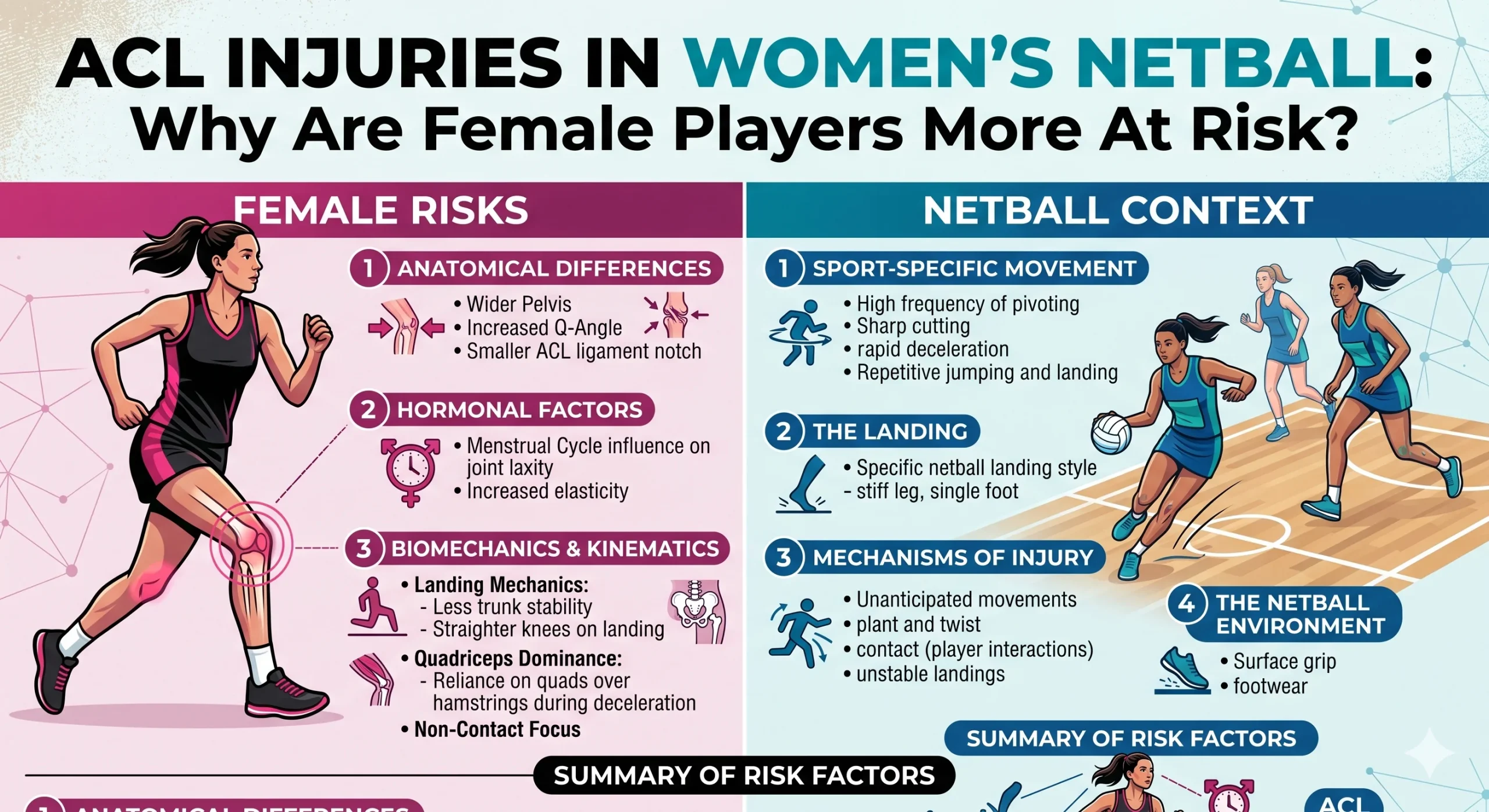
Why Female Netball Players Face a Higher Risk of ACL Injuries
Netball is a game of lightning-fast pivots, sudden decelerations, and high-flying intercepts. It’s thrilling to watch and demanding to play. However, beneath the spectacular athleticism lies a frustrating and painful reality: Anterior Cruciate Ligament (ACL) injuries are disproportionately sidelining female players.
While ACL tears are a known hazard in many sports, women’s netball sees a strikingly high incidence rate. To understand why, we have to look at a perfect storm of anatomy, biomechanics, and the unique rules of the game itself.
1. The Anatomy: The “Q-Angle” and Hormones
Biologically, women are predisposed to a higher risk of knee injuries due to two main factors:
- The Q-Angle: Women naturally have wider hips to facilitate childbirth. This creates a sharper angle between the hip and the knee, known as the Q-angle. A larger Q-angle places more inward stress on the knee joint (a position called dynamic valgus or “knock-knees”), especially during landing and cutting maneuvers.
- Hormonal Fluctuations: Research suggests that estrogen and relaxin—hormones that fluctuate during the menstrual cycle—can increase ligament laxity (looseness). When ligaments are more pliable, they absorb less shock, leaving the joint more vulnerable to tearing under sudden strain.
2. Biomechanics: How Women Move
Studies in sports biomechanics show that men and women jump, land, and cut differently.
- Upright Landings: Female athletes tend to land from jumps with straighter knees and hips (a more upright posture). Landing flat-footed or stiff-legged forces the bones and ligaments of the knee to absorb the brunt of the impact, rather than letting the large muscles of the thighs and glutes cushion the blow.
- Quadriceps Dominance: Many female athletes are “quad-dominant,” meaning they rely heavily on their quadriceps muscles to stabilize their knees, while their hamstrings are relatively weaker. Because the quadriceps pull the shinbone forward, an over-reliance on them puts direct, intense stress right on the ACL.
3. The Netball Factor: Sudden Stopping
Every sport has its risks, but netball’s specific rules amplify the danger.
Unlike basketball or handball, where players can run with the ball or use a layup to dissipate momentum, netball rules demand an immediate stop upon catching the ball.
The “Footwork” Trap: A player sprinting at full speed must ground their landing foot and stop within one to two steps. This creates a massive, sudden deceleration force. If the landing isn’t perfectly balanced, or if a player tries to change direction rapidly on that planted foot, the ACL often bears the catastrophic weight of that momentum.
How to Fight Back: Injury Prevention
The statistics might sound daunting, but an ACL injury doesn’t have to be an inevitability. Dynamic warm-up programs—most notably the Netball KNEE Program developed by Netball Australia—have proven incredibly effective.
| Focus Area | What It Does | Example Exercises |
| Landing Tech | Teaches soft landings with bent knees and hips aligned. | Drop jumps, vertical hops with hold. |
| Hamstring Strength | Balances out quad-dominance to protect the shinbone. | Nordic hamstring curls, single-leg deadlifts. |
| Core & Glutes | Keeps the hips stable, preventing the knees from collapsing inward. | Plank variations, crab walks with resistance bands. |
The Bottom Line
Female netballers face a steep uphill battle against biology and the strict rules of the sport they love. However, by shifting the focus from just playing the game to actively training how to land and pivot, players can protect their knees and stay on the court where they belong.