





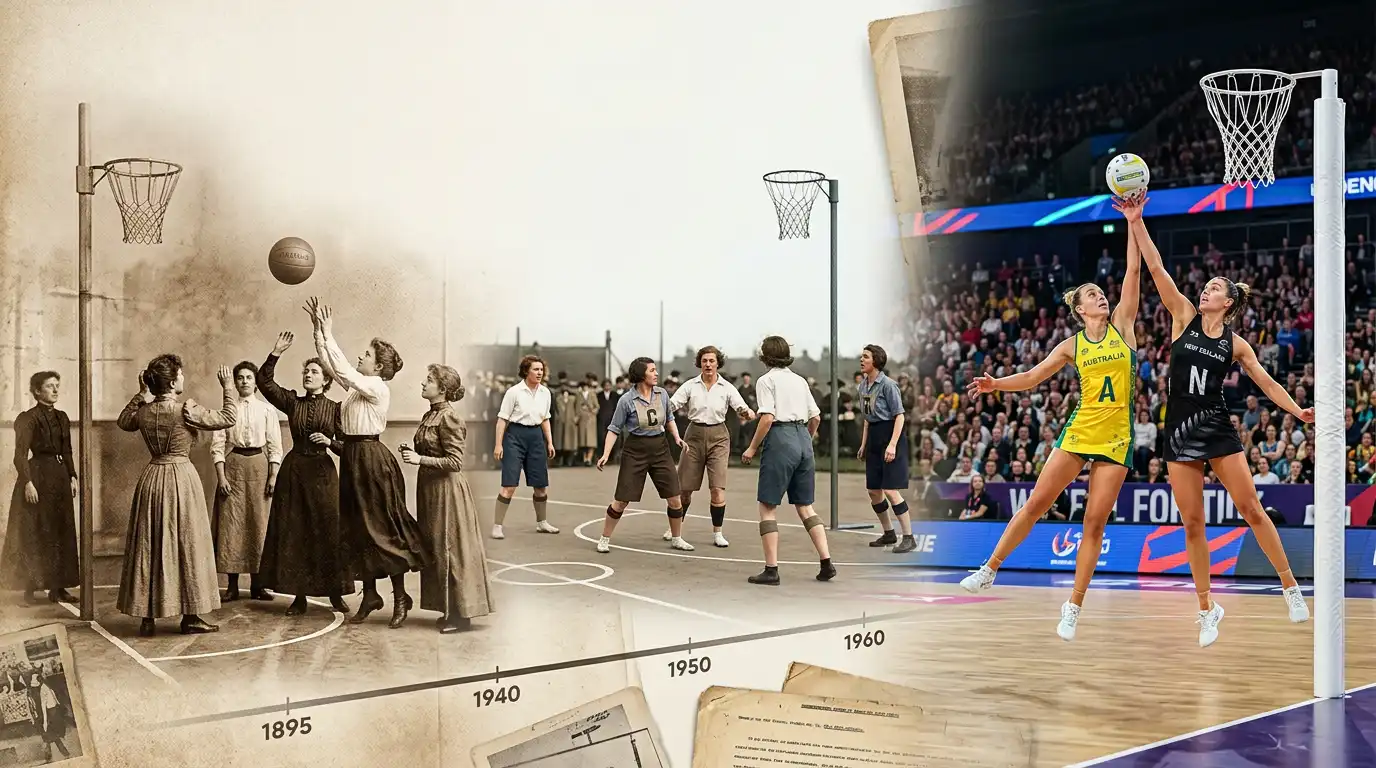
Netball has evolved from the early development of basketball into one of the world’s most popular team sports. Today, it is played across continents, with international tournaments, professional competitions and millions of players and fans following the game.
But the story of netball began more than a century ago. Its development from an adaptation of basketball into a distinct sport is closely connected to the growth of women’s sport and the expansion of international competition.
For the latest stories, competitions and information from across the sport, visit Netball.com.
The Origins of Netball
The history of netball can be traced back to the development of basketball in the 1890s.
In 1891, Canadian-American physical education instructor James Naismith invented basketball at the School for Christian Workers in Springfield, Massachusetts, now known as Springfield College. The new indoor game quickly spread and was soon adapted for different environments and groups of players.
Basketball was introduced to women shortly after its creation, but versions of the game began developing differently depending on where they were played.
One important figure in this early development was Clara Baer, a physical education instructor in New Orleans. In 1895, Baer received a copy of Naismith’s basketball rules and court diagrams.
Her interpretation of the court markings helped establish a style of play in which players were restricted to particular areas of the court. These early adaptations would eventually contribute to several of the characteristics that distinguish netball from basketball today.
Netball Arrives in England
The game crossed the Atlantic and reached England towards the end of the 19th century.
A significant milestone occurred in 1897 at Madame Bergman’s College in Dartford. A version of basketball was introduced with several differences from the original game, including the removal of backboards from the goals.
As the sport developed, it became increasingly associated with women and girls. Social attitudes towards women’s participation in physical activity also influenced the way the game was organised and played.
During these early years, there was no single universal rulebook. Different regions could have variations in the number of players, court divisions and playing regulations.
These differences would eventually create a need for greater standardisation as the sport spread internationally.
From Women’s Basketball to Netball
Over time, the game gradually developed its own identity and became distinct from basketball.
The term “net ball” began to emerge, reflecting the use of nets attached to the goal rings. Rules continued to change, and some early versions of the sport allowed forms of dribbling that would later disappear from the game.
As participation increased, the need for a consistent set of rules became more important.
A major development came in 1926 with the formation of the All England Net Ball Association. Efforts were also made to formalise the rules and establish greater consistency in how the sport was played.
These developments helped create the foundations for the modern version of netball.
The First International Matches
Netball’s international growth initially faced a major challenge: countries were often playing different versions of the game.
One of the most important early international encounters took place in 1938, when Australia hosted New Zealand during a tour.
At that time, the two countries had different approaches to the game. Australia played with seven players, while New Zealand traditionally used nine.
For their international meeting, the teams adopted seven-a-side rules. Australia won the historic contest 40–11.
The match became an important milestone in the development of international netball and highlighted the growing need for countries to agree on common rules.
England entered international competition in 1949, playing its first international matches against Scotland and Wales. England won both games 25–3.
These early encounters helped establish netball as an increasingly international sport.
Creating a Global Standard for Netball
By the 1950s, netball was being played in an increasing number of countries, but significant differences in rules remained.
The importance of establishing a globally recognised standard became particularly clear after an Australian team toured England in 1957.
Representatives from England, Australia, New Zealand, South Africa and the West Indies subsequently met in Sri Lanka to discuss the differences between national versions of the game.
The meeting resulted in the formation of the International Federation of Women’s Basketball and Netball, providing an important foundation for the sport’s international governance.
Rules were subsequently formalised, while plans were developed for an international championship that would bring the world’s leading teams together.
The First Netball World Championships
The first World Netball Championships were held in England in 1963.
The tournament was a landmark moment for the sport, giving leading netball nations an opportunity to compete internationally under a standardised set of rules.
Since then, the World Netball tournament has become the sport’s premier international competition.
The event has played an important role in increasing the global profile of netball while strengthening rivalries between leading nations and providing opportunities for emerging teams to compete at the highest level.
Fans looking to follow the sport’s major competitions can explore major netball events, including tournaments and other important fixtures from across the netball calendar.
Netball and the Commonwealth Games
Another major milestone came with netball’s inclusion in the Commonwealth Games.
Netball made its official Commonwealth Games debut in 1998 in Kuala Lumpur, Malaysia.
Australia won the inaugural gold medal, while New Zealand claimed silver and England took bronze.
Since then, the Commonwealth Games have become one of the most important international stages for netball outside the World Cup.
The competition has helped introduce the sport to wider audiences and has given elite players the opportunity to compete for one of the most prestigious honours in Commonwealth sport.
Netball and the Olympic Dream
Netball’s ambition to become an Olympic sport has been an important part of its international development.
The International Olympic Committee recognised the sport’s international federation in 1995, representing an important step in raising netball’s standing within the international sporting community.
However, recognition by the IOC does not automatically result in inclusion on the Olympic programme.
Netball continues to work towards expanding its international reach and participation. Olympic inclusion would provide significant opportunities for greater visibility, investment, broadcasting and participation.
For many players, supporters and administrators, becoming an Olympic sport remains one of netball’s biggest long-term ambitions.
The Growth of Modern Netball
Netball has changed considerably since its early beginnings.
The modern game is faster, more athletic and increasingly professional. Developments in sports science, coaching, strength and conditioning, nutrition and technology have transformed how elite players prepare and compete.
Professional and semi-professional competitions have also created new opportunities and pathways for athletes.
Today, netball features major domestic leagues, international competitions and elite events that attract audiences around the world. Players have also become increasingly visible through television coverage, digital media and social platforms.
Fans can keep up with the latest netball news and updates, including match reports, results, player stories and developments from around the sport.
At the same time, the sport continues to expand beyond its traditional strongholds, introducing netball to new communities and new generations of players.
Tracking the Modern Game
Statistics and rankings have become an important part of following modern netball.
Team rankings, match results and performance statistics provide fans with another way to understand how teams are performing and how the international game continues to evolve.
Whether following a major tournament or comparing performances between international teams, supporters can explore netball rankings and match statistics to stay informed about the numbers behind the game.
A Global Future for Netball
More than a century after its early development, netball has become a truly international sport.
From its origins in the evolution of basketball to major competitions such as the Netball World Cup and Commonwealth Games, the sport has continually developed while retaining the teamwork, tactical awareness and specialist skills that make it unique.
The history of netball is also closely connected to the growth of women’s sport. What began as an adaptation of basketball eventually developed into a distinct sport with its own rules, competitions, athletes and international identity.
As netball continues to expand into new markets and attract new generations of players and fans, its history provides an important reminder of how far the sport has come.
From the Past to the Future
The story of netball is still being written.
Growing professional competitions, increasingly competitive international teams, major global tournaments and expanding digital coverage are helping the sport strengthen its presence on the world stage.
From its 19th-century beginnings to today’s international game, the evolution of netball has been remarkable.
And with a new generation of players taking up the sport around the world, the next chapter of netball history could be its most exciting yet.
Stay connected with Netball.com for the latest news, results, statistics and events from the world of netball.