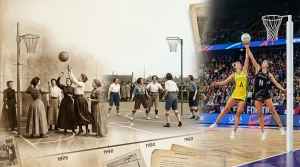





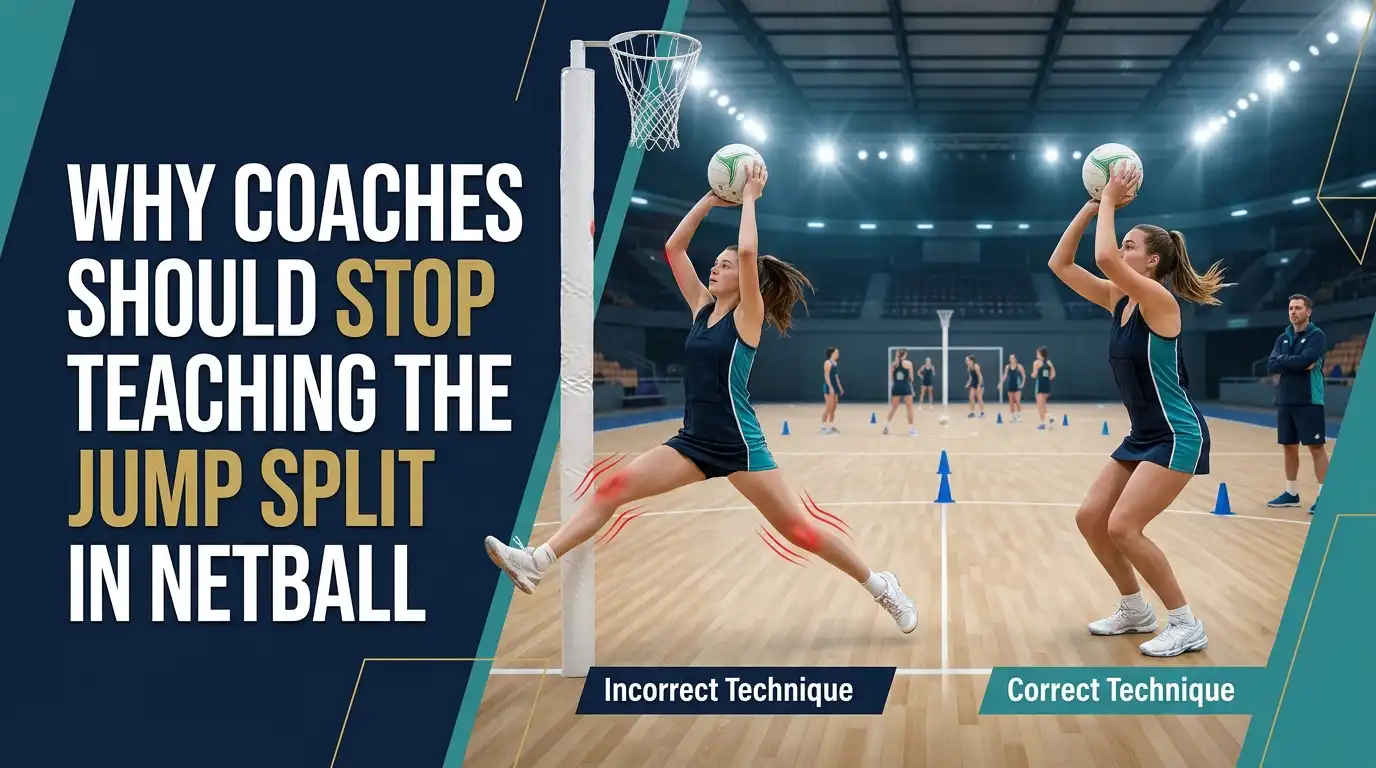
For decades, the jump split landing has been a familiar technique in netball. Popularised by elite shooters and often seen at junior competitions, the movement involves leaping toward the post and landing in a wide, staggered stance to gain better shooting position.
It certainly looks effective—and when performed by experienced elite athletes, it can be.
The concern arises when young players are taught to copy the technique before they have developed the strength, stability, and movement control required to perform it safely.
As our understanding of biomechanics and injury prevention continues to evolve, many coaches are questioning whether the jump split remains an appropriate technique for developing athletes.
The Biomechanics Behind the Jump Split
A jump split places considerable stress on the body, particularly when performed while catching a high pass, absorbing defensive contact, or rotating in the air.
During the movement, the body experiences three major types of loading:
- High-impact landing forces
- Uneven (asymmetrical) loading
- Rotational or twisting forces
When combined, these forces significantly increase the demands placed on the lower body.
High-Impact Landing Forces
Every landing requires the body to absorb force as it decelerates against gravity.
Research has shown that landing from a jump can generate forces equivalent to four to six times an athlete’s body weight, placing substantial stress on the knees, hips, and ankles.
Elite athletes are capable of managing these forces because they possess years of strength training, refined landing mechanics, and exceptional neuromuscular control.
Most junior players simply haven’t developed these qualities yet.
Uneven Loading
In a jump split, athletes rarely land with equal weight on both legs.
Instead, one leg often absorbs the majority of the impact, creating uneven loading across the lower limbs.
Repeated exposure to these asymmetrical forces increases stress on joints, muscles, and connective tissue.
Rotational Stress
The jump split frequently involves rotating toward the post while the feet land in different directions.
When the foot becomes fixed on the floor while the body continues rotating, significant twisting forces travel through the knee.
This mechanism is widely recognised as one of the major contributors to serious knee injuries.
Why This Matters for Young Athletes
Developing athletes are still growing.
Their muscles, tendons, ligaments, and bones mature at different rates, meaning their bodies are often less prepared to tolerate high-impact movements.
Without sufficient:
- Lower-body strength
- Glute and hamstring development
- Core stability
- Landing mechanics
- Eccentric (deceleration) control
young players may struggle to absorb these forces safely.
The result is an increased risk of injury during high-speed movements and awkward landings.
What the Research Tells Us
Sports medicine research consistently highlights landing mechanics as a significant factor in lower-limb injuries.
ACL Injuries
Female athletes are estimated to be four to eight times more likely than males to suffer an ACL injury in sports involving jumping, landing, and rapid changes of direction.
Poor landing mechanics, excessive knee valgus (knees collapsing inward), and rotational loading are all recognised risk factors.
Netball’s explosive nature means these movements occur repeatedly throughout every match.
Meniscal Damage
Landing with the knee twisted while the foot remains planted increases compressive and shear forces inside the knee joint.
These forces can contribute to meniscal injuries, which may have long-term consequences for joint health and mobility.
Growth Plate Considerations
Growth plates remain open throughout adolescence, often until the late teenage years.
During this period, bones frequently grow faster than muscles and tendons can adapt, reducing flexibility and movement control while increasing injury susceptibility.
Why Coaches Continue to Teach It
Most coaches introduce the jump split with positive intentions.
The movement can:
- Bring shooters closer to the post
- Improve shooting angles
- Create separation from defenders
- Replicate techniques used by elite players
However, elite athletes spend years developing the physical qualities that allow them to perform these movements safely.
They typically benefit from:
- Structured strength and conditioning
- Professional physiotherapy support
- Sports science monitoring
- Progressive landing training
- Advanced movement coaching
Junior players rarely have access to the same level of preparation.
Teaching developing athletes to replicate elite movement patterns before they possess the required physical capacity may expose them to unnecessary injury risk.
What Coaches Can Teach Instead
Rather than relying on jump splits, coaches can help young shooters gain better positioning using safer and more effective techniques.
Improve Court Positioning
Teach players to use:
- Front cuts
- Lateral drives
- Strong leads
- Early body positioning
These movements allow shooters to receive the ball closer to the post without excessive jumping.
Teach Players to Hold the Defender
Encourage shooters to establish body position against their defender before receiving the pass.
Once balanced, players can simply:
- Drop the back foot
- Rotate smoothly
- Turn toward the post
This creates excellent shooting position without exposing the body to high-impact landings.
Reinforce Controlled Two-Foot Landings
Where jumping is necessary, focus on:
- Balanced two-foot landings
- Even weight distribution
- Soft knee flexion
- Hips absorbing impact
- Knees tracking over the toes
Good landing mechanics should become second nature before introducing more advanced movements.
Build Strength First
Strength should underpin every advanced movement skill.
Include exercises such as:
- Bodyweight squats
- Split squats
- Glute bridges
- Single-leg balance work
- Landing and deceleration drills
- Core stability exercises
Developing these physical qualities gives athletes the foundation required for safe, efficient movement.
Coaching for Long-Term Athlete Development
Every movement coaches teach shapes how young athletes perform in the future.
Repeatedly practising poor movement patterns reinforces habits that may increase injury risk.
Conversely, teaching efficient, controlled movement builds stronger, more resilient athletes capable of performing at higher levels throughout their careers.
The objective should not simply be to help players score today—it should be to help them stay healthy and continue enjoying the game for years to come.
By prioritising sound biomechanics, progressive strength development, and safe landing techniques, coaches can play a vital role in protecting young athletes while supporting long-term performance and success.